
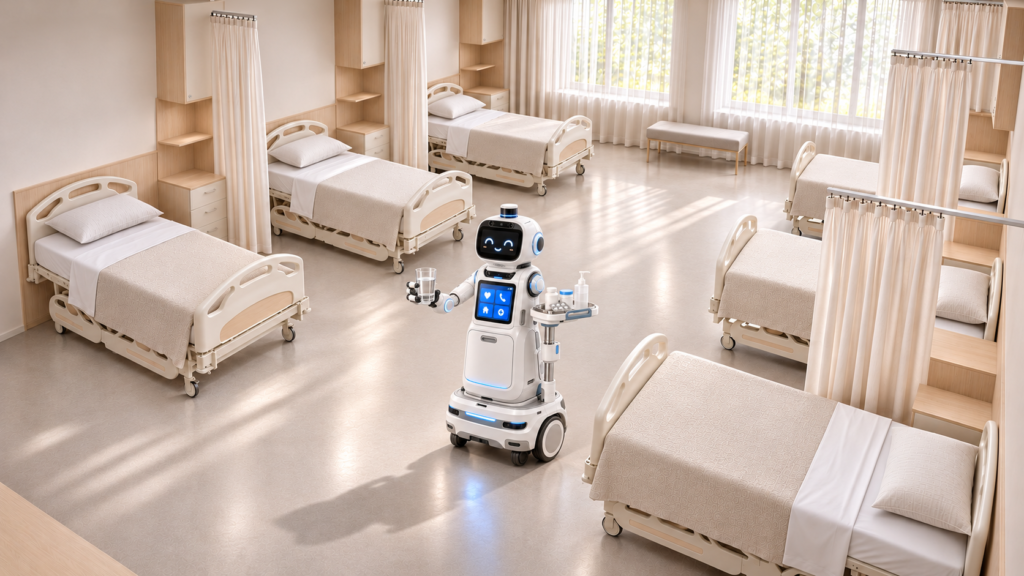
BIOFAST continues to develop AI-powered care robots around the daily workflows of long-term care facilities. The company plans to integrate autonomous navigation, environmental perception, and intelligent obstacle avoidance so that the robots can deliver everyday items, documents, and care supplies. By combining AI with mobile robotics, BIOFAST aims to reduce the time care staff spend collecting and delivering items, allowing them to devote more time to residents’ care needs.
Designing Autonomous Navigation Tasks Around Care Workflows
Supply delivery in long-term care facilities involves moving between rooms, shared spaces, and staff work areas. Robot development therefore needs to account for travel routes, corridor layouts, and the movement of people. BIOFAST has made autonomous navigation a core area of research and development. It plans to combine environmental perception and obstacle avoidance so that robots can recognize their surroundings and travel to designated locations based on assigned tasks. Using real-world care scenarios, BIOFAST will progressively evaluate how the robots navigate, stop at designated locations, and hand over items, so that delivery can fit into each facility’s daily operations.
Integrating Sensing and Control into a Care Support Platform
BIOFAST’s AI care robot is built around a mobile manipulation platform designed to integrate sensing, robot control, and task management. Supply delivery is one of its primary applications. As development progresses, BIOFAST plans to integrate robotic arms, voice interaction, and other care support functions. Development will also address how the robots interact with staff and residents while carrying out navigation tasks. The ability to handle changes in the environment, ease of use, and system reliability will guide functional testing and refinement.
Advancing Prototype Development for Long-Term Care Facilities in Taiwan and Japan
BIOFAST is initially focusing on Taiwan and Japan and continues to explore opportunities to work with long-term care facilities, research institutions, and industry partners. The company will schedule functional tests and on-site validation based on its development results. With safety, reliability, and compatibility with care workflows as development priorities, BIOFAST aims to put autonomous mobile robotics to practical use in long-term care settings.
BIOFAST Advances AI Care Robot Development for Autonomous Navigation and Supply Delivery in Long-Term Care Facilities
11
11 月