PRECISELY CONTROLLING
Injection Molding
The Injection Molding Process involves injecting heated material into a mold, where it cools and solidifies to form the desired product.

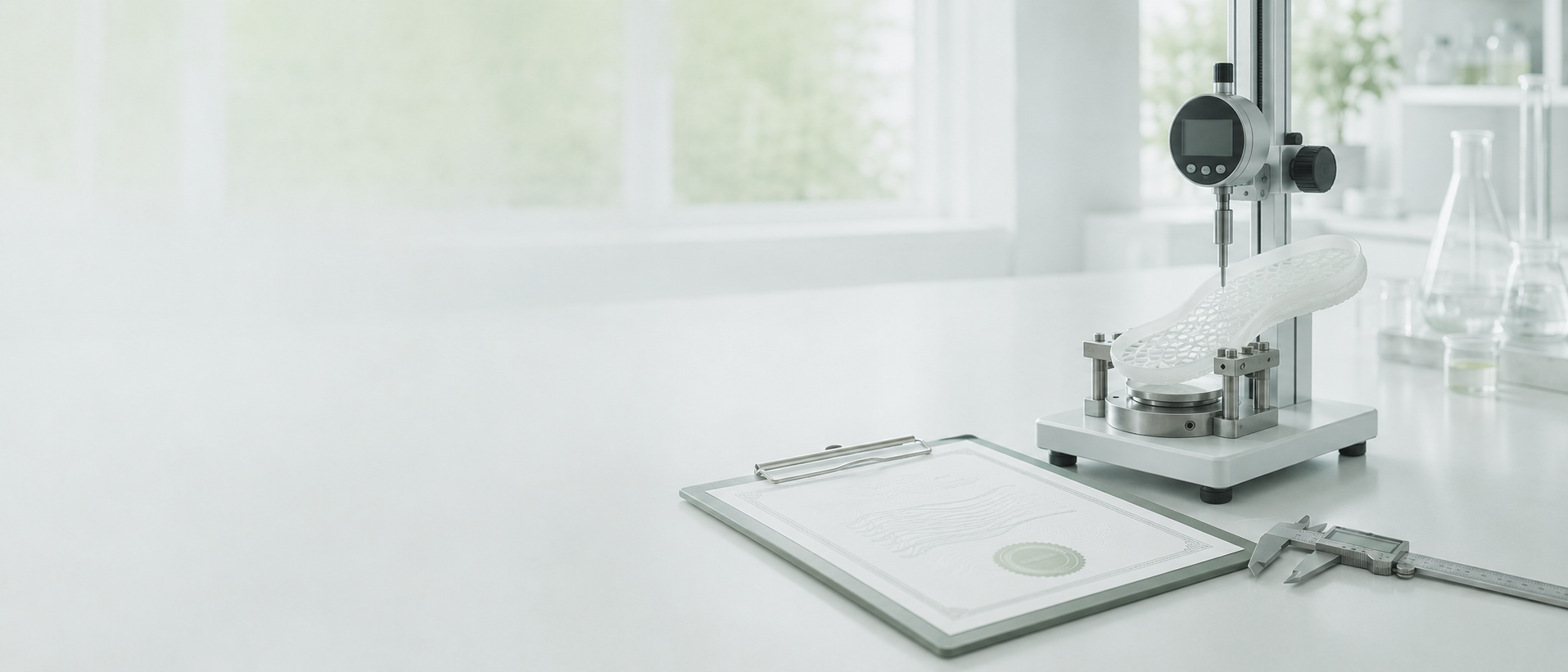
Biofast continuously invests in research and development as well as manufacturing equipment and process capabilities. By combining gel material compounding, molding and processing, composite material integration, product testing, and quality management, we have established a comprehensive workflow spanning material development, product design, and mass production.
Through proprietary technologies, specialized equipment, and extensive manufacturing expertise, we provide customized development solutions tailored to diverse product requirements. Our approach emphasizes consistent quality, production efficiency, and product uniformity, effectively transforming innovative concepts into commercially viable products.
The Injection Molding Process involves injecting heated material into a mold, where it cools and solidifies to form the desired product.
The Casting Process involves pouring or injecting a prepared liquid material into a mold, allowing it to completely fill the mold cavity. The material then undergoes curing, solidification, and demolding to form the finished product.
The Casting Process involves pouring or injecting a prepared liquid material into a mold, allowing it to completely fill the mold cavity. The material then undergoes curing, solidification, and demolding to form the finished product. By precisely controlling the casting volume, material flow characteristics, and curing time, this process enables accurate reproduction of intricate product details and contours, making it suitable for a wide range of molding applications and customized product designs.
The Dip Molding Process involves immersing a mold into a liquid material, allowing the material to form a uniform layer on the mold surface. The product is then formed through curing or solidification, followed by demolding.
The Dip Molding Process involves immersing a mold into a liquid material, allowing the material to form a uniform layer on the mold surface. The product is then formed through curing or solidification, followed by demolding. The number of dipping cycles, coating thickness, and surface texture can be adjusted according to specific product requirements, making this process suitable for manufacturing products that require softness, flexibility, or conformable coverage.
The Foam Molding Process uses controlled material formulations and molding parameters to create a uniform cellular foam structure within the mold.
The Foam Molding Process uses controlled material formulations and molding parameters to create a uniform cellular foam structure within the mold. The resulting products can combine lightweight properties, softness, cushioning, and structural support. Foam density, thickness, and hardness can be customized according to specific product requirements, enabling applications across a wide range of product designs and structural configurations.
Precision Sewing combines skilled craftsmanship with specialized sewing equipment. Appropriate threads, stitch lengths, and sewing techniques are carefully selected according to each product's structural requirements.
Precision Sewing combines skilled craftsmanship with specialized sewing equipment. Appropriate threads, stitch lengths, and sewing techniques are carefully selected according to each product’s structural requirements. The process emphasizes neat and consistent stitching, strong seams, and uniform appearance. It accommodates various materials and multilayer structures, ensuring precise finishing and reliable assembly of product components.
Ultrasonic Welding uses high-frequency vibrations to generate localized heat, rapidly fusing material contact surfaces to form a secure bond.
Ultrasonic Welding uses high-frequency vibrations to generate localized heat, rapidly fusing material contact surfaces to form a secure bond. This process eliminates the need for conventional stitching or large amounts of adhesives, producing cleaner and more consistent joints while maintaining production efficiency and bonding reliability. It is particularly suitable for processing thermoplastic materials.
Precision Die Cutting ensures accurate cutting based on product patterns, dimensions, and material properties, maintaining consistent shapes and dimensional accuracy across individual components.
Precision Die Cutting ensures accurate cutting based on product patterns, dimensions, and material properties, maintaining consistent shapes and dimensional accuracy across individual components. High-quality cutting not only improves material utilization but also minimizes errors during subsequent sewing and assembly processes, ensuring seamless integration of components into downstream manufacturing operations.
The Heat Transfer Printing Process uses controlled temperature, pressure, and processing time to transfer patterns, text, or identification marks onto product surfaces.
The Heat Transfer Printing Process uses controlled temperature, pressure, and processing time to transfer patterns, text, or identification marks onto product surfaces. Process parameters can be adjusted according to different material properties and design requirements to ensure clear and consistent transfer results, providing a versatile solution for product surface decoration and customized branding applications.
Compared with conventional tooling, which often involves high costs and lengthy development cycles, BIOFAST's Rapid Tooling System enables efficient mold design, fabrication, and molding validation based on product structures, material properties, and actual manufacturing requirements.
Compared with conventional tooling, which often involves high costs and lengthy development cycles, BIOFAST’s **Rapid Tooling System** enables faster mold design, fabrication, and molding validation based on product structures, material properties, and actual production requirements.
Under suitable product and manufacturing conditions, tooling development costs can be reduced to approximately **one-quarter of those associated with conventional molds**, significantly shortening development lead times and reducing initial investment. The system also supports rapid prototyping, trial production, and subsequent mass manufacturing.
By combining rapid tooling development with flexible manufacturing capabilities, BIOFAST helps customers lower the barriers to new product development and accelerate the transition from design concepts to market-ready products. This approach is particularly suitable for medical braces, functional products, smart assistive devices, and customized product development.